My least favorite time of the school year to plan for has always been the first unit back. There is so much pressure to get everything “right” on day one when students show up:
- Teach all of your routines with high expectations
- Teach all of your rules and consequences with consistency
- Build positive relationships with every student and ensure that all of them love you and your class
- Also teach real content aligned to the standards
- Have your room beautifully decorated
- And be sure to turn in those minute-by-minute plans for the first 3 days
- Also have those emergency sub plans ready to go
It is too much for anyone to tackle without shedding a few tears and succumbing to bouts of stress eating.
Here are the reasons these four games are the answer to all of your problems:
- They can be used throughout the year when you introduce a new song, introduce a new concept, or have a substitute day– this makes the games themselves a routine that you will come back to over and over
- The games are simple, require no materials, and very little can go wrong. You won’t have to teach too many rules yet. (I have a lot of rules about xylophones– no one has the patience for that in September)
- Games are inherently fun, which makes it easy for you to be relaxed and show your fun side. When you’re relaxed and kids are having fun, building positive relationships is easy.
- You can use these games to introduce concert repertoire, review concepts from the previous year, or introduce a new concept
- You can do these games with every grade level! This simplifies your beginning-of-the-year planning and your emergency sub planning!
Bonus: you don’t have to print, laminate, or cut anything!
Game #1: Secret Beat Keeper
Many students may already know this game, as it is often played in morning meetings and in after-school programs. Of course, we make it a little bit more musical in music class! Recommended for K-5th!
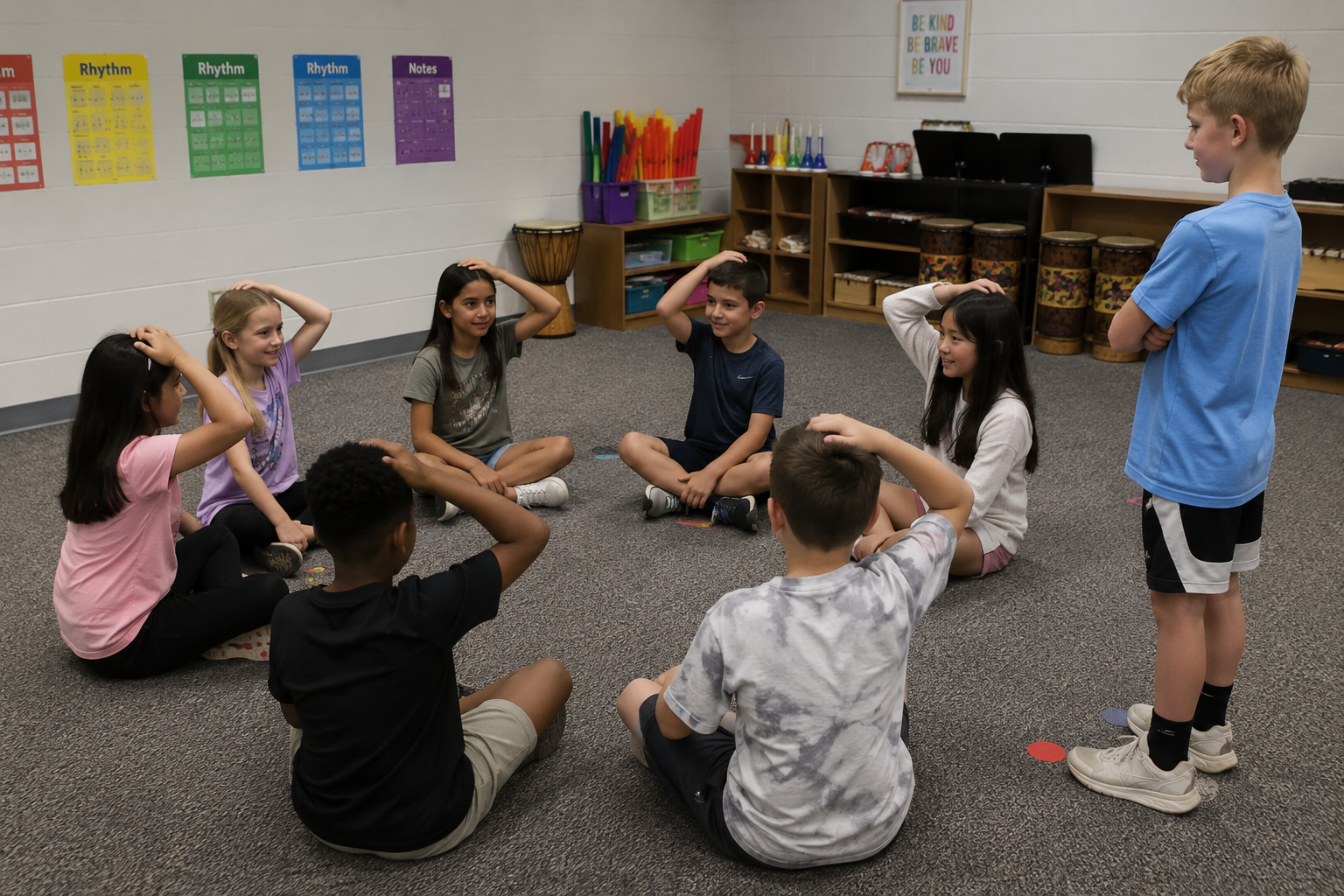
Basic game:
One student leaves the room– this person is the guesser. The teacher picks a “secret beat keeper” to lead steady beat motions. The rest of the class copies what the secret beat keeper does. The guesser returns and must guess who is leading the motions. These are all the ways I vary it:
Levels of Difficulty:
Level 1: Students do a single-level beat motion (patting, clapping, tapping their shoulders) without music
Level 2: Same as level 1, but put on a recorded song
Level 3: Students do a two-level beat motion (pat/clap, floor/pat, head/shoulders)
Level 4: Students do a two-level motion with a given rhythm (doot-de, doot, doot-de, doot OR ti-ti, ta, ti-ti, ta is a great starting point)
Level 5: Show students a rhythm on a flashcard and ask them to make a two-level motion for the rhythm. There is no limit to how challenging this can become!
You could also make any of these levels more challenging by asking students to sing a song while doing the beat motions.
Note: Level 4 can be a great way to practice quarter note/eighth note rhythms for 5th graders who have never had music!
Game #2: Bounce-Catch
Do you know the song and game “Bounce High Bounce Low?” It’s a so-mi song used in many Kodaly classrooms. But guess what– you can take the game and apply it to ANY song. Recommended for 1st-5th!
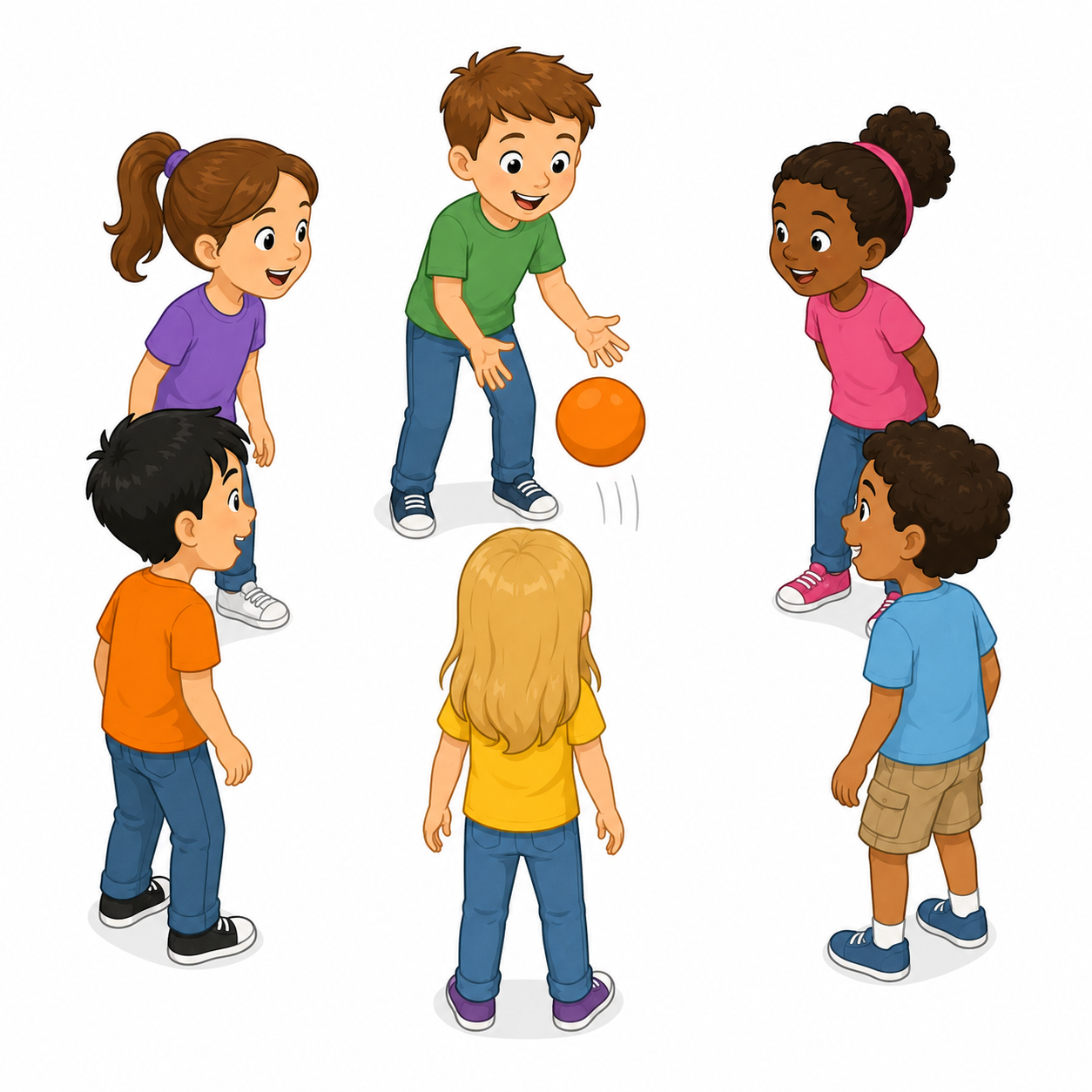
Basic game:
Students bounce and catch the ball to the beat of the song. If a student fails to bounce or catch the ball on the beat, they have to sit down. I ask all of them to chant “bounce, catch, bounce, catch” while patting their legs and clapping their hands to the beat when we start.
Here are all the ways I vary this game:
-
Play a recorded song
-
Introduce a new song by singing it for students as they keep the beat
-
Have students be responsible for the singing while playing
I like to introduce the game as having different levels. Depending on the grade, you might stay at level 1 for the year, or you might advance to level 4 in one class period (probably only with 5th grade).
Levels of Difficulty:
Level 1: Teacher stands in the center of the circle and bounces the ball to students, going around the circle in order. Students bounce the ball back to the teacher. (1st grade will probably stay here)
Level 2: Teacher stands in the center of the circle, but could bounce the ball to any student at any time– this keeps them on their toes!
Level 3: Students bounce the ball to the person next to them, going around the circle in order.
Level 4: Students can bounce the ball to anyone in the circle at any time (this usually works best with 4th & 5th grade)
Game #3: Four Corners
This is another game that is commonly played in non-music classrooms. It is one of the easiest to adapt to ANY concepts you might be covering in class. Recommended for K-5th.
Basic game:
Project an image of four quadrants like the one below:
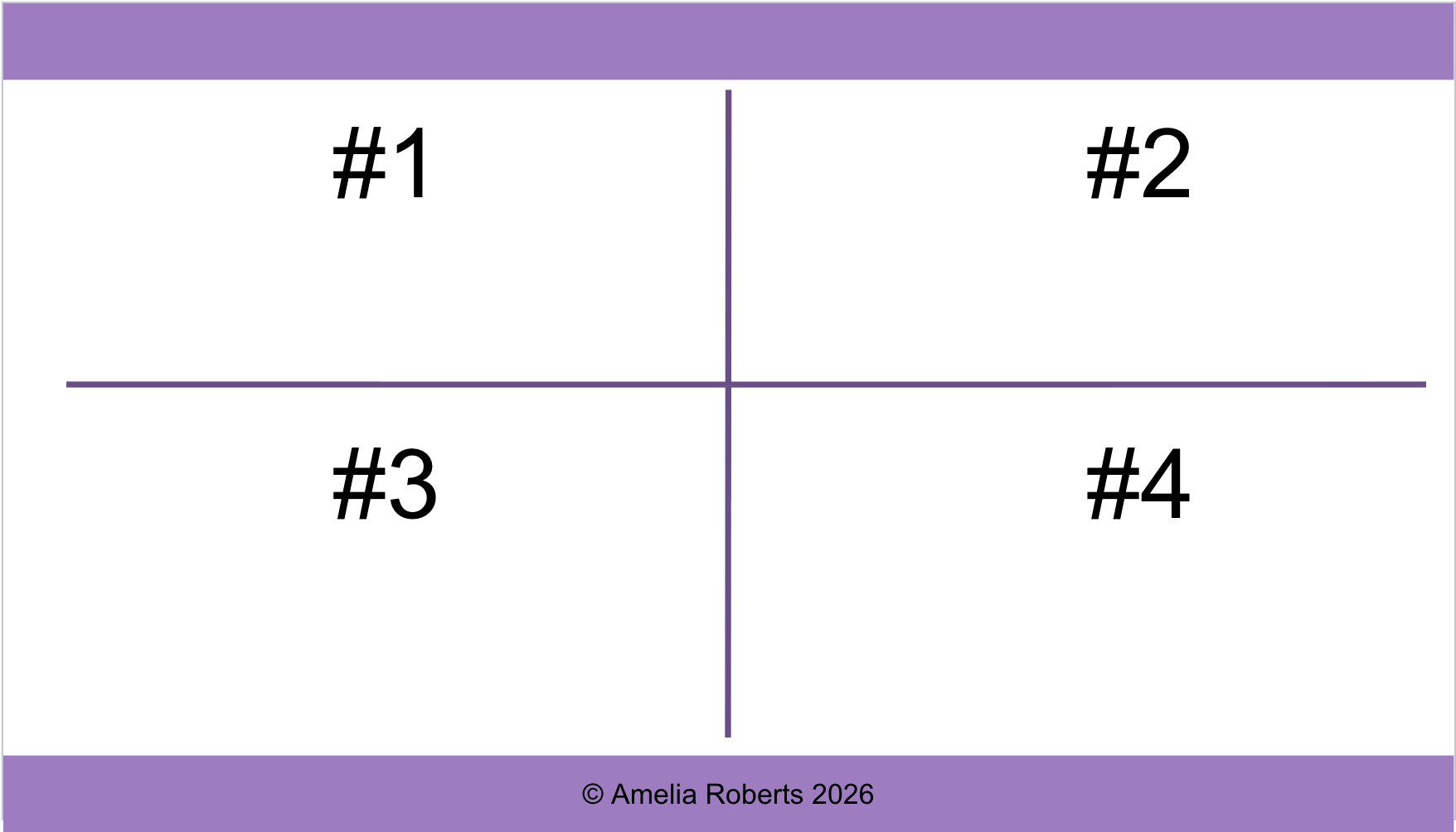
Each quadrant represents a corner in the classroom. When the teacher says “4 corners,” students walk to one of the corners. A “caller” stands at the front of the room with his/her back to the class. They call out one of the corners, for example, “corner 1.” Everyone who is in that corner is now “out.” Students learn that they must be quiet as they are moving to their corner so the caller doesn’t hear where they have gone.
Now this is how you make it more musical:
Instead of just putting numbers in the quadrants, you put a rhythm pattern, a notation symbol, or a picture of an instrument in the quadrants. The “caller” has to read the rhythm on solfege, say the name of the notation symbol (quarter note, treble clef), or say the name of the instrument (french horn).
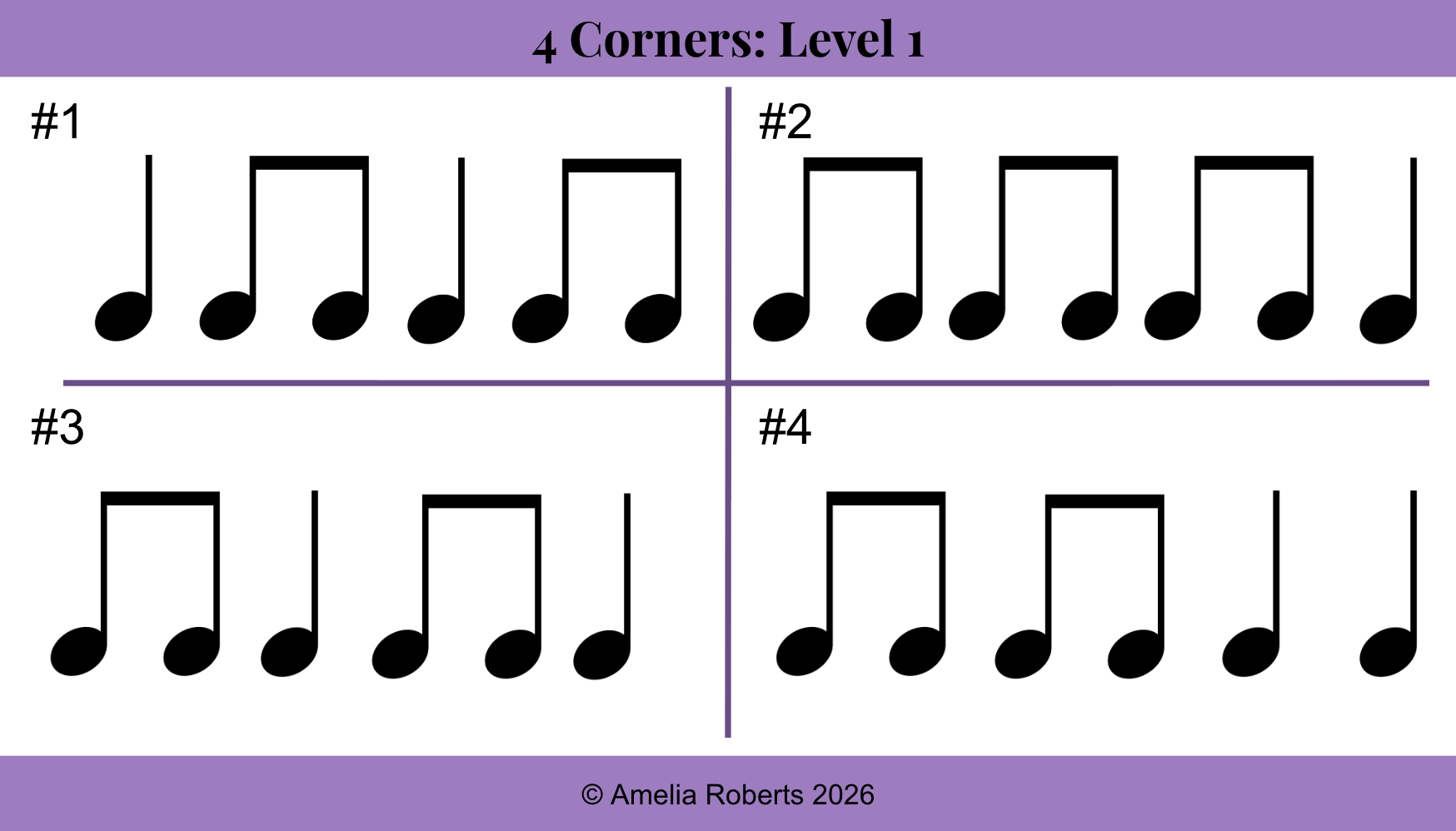
Make it less random and more challenging:
When the caller calls out a corner after students pick their corners, the game is random and mostly tests the knowledge of just the “caller” (though I do ask all of the students to point to the corner that is out). If the caller calls out a corner before students pick their corners, students have to know which symbol/rhythm was called and avoid that corner. That means that they have 3 corners to choose from, but must avoid the corner that was called.
It is easy enough to make your own visuals for 4 corners, but if you would like to save time, you can purchase some 4 corner games from my TpT store
Game #4: Pass The Beat Around The Room
This game is very simple, but also very fun. The first time I do this with any class, they often exclaim, “Can we do it again?!” Recommended for 3rd-5th
Basic game:
Students stand in a circle. Each person says one beat of the phrase “Pass the beat around the room.” They go in order around the circle. “A-round” is split between two different people (only one syllable/beat per person). After “room,” the next person waits one beat before starting it over. If students miss the beat, come in early, say the wrong word, say too many words, etc. they must sit down.
This game doesn’t have as much potential for variations, but students love it! The main variation is playing with the tempo. You can make it slightly faster as the circle gets smaller. You can also give students an opportunity to request different tempi by name (andante, presto, largo) and then play a metronome to match the tempo they request.